Monday, 14 December 2020

Salesforce

Salesforce CRM>> Customer Relationship Management.

Its a website via which you can save details about your companies customers and orders they have made etc .

Is makes it easier to mange everything in a excel sheet and offer additional features as tracking sales etc.

Tuesday, 11 August 2020

Podio

 Podio is a  Communication and Project Management tool.

Eg : A Design company who does a Ad campaign for Pepsi

Using a this tool. The various departments in the Design company can

  •  track the budget 
  • collaborate ideas and work design samples  
  • assign tasks with in the team  and prioritize task
  • Create Automation's >> Once a design is approved it goes to finance for cost analysis

Wufoo

 https://www.wufoo.com/


A form builder that makes it easy to create registration forms, application forms, surveys, contact forms, payment forms and more.

Pros:

Very user friendly 

Thursday, 9 July 2020

Network-attached storage

Network-attached storage is a file-level computer data storage server connected to a computer network providing data access to a heterogeneous group of clients. NAS is specialized for serving files either by its hardware, software, or configuration.

Tuesday, 30 June 2020

POE - Pover Over Ethernet

Power over Ethernet, or PoE, describes any of several standard or ad hoc systems that pass electric power along with data on twisted pair Ethernet cabling.

Friday, 6 March 2020

QNAP - Prodcut Reveiw

A Product used for NAS - Network Addressed Storage

So Its a large Storage device - Kind of like your personal storage.
https://www.youtube.com/watch?v=TChe1A6L3Yg

Monday, 24 September 2018

What is a Dynamic IP Address?

First, let’s explain what an IP address is. An Internet Protocal Address or IP address for short, is like your computer’s phone number. Without it, your computer wouldn’t be able to connect to the Internet. Every computer, tablet, smart phone, and Internet enabled device has it’s own IP address (even some light bulbs have an IP address these days).  An IP address consists of numbers and periods (192.168.1.1).
So, what is a dynamic IP address? Well, a dynamic IP address is one that changes from time to time and isn’t always the same. If you have a residential cable or DSL service, you most likely have a dynamic IP address. Internet Service Providers (ISPs) provide customers with a dynamic IP addresses because they are more cost effective. Instead of one IP address always being yours (a static IP address), your IP address is pulled from a pool of addresses and then assigned to you. After a few days, weeks or sometimes even months, that number gets put back into the pool and you are assigned a new number.
This is why a dynamic IP address can make it tricky to remotely access your PC, DVR or webcam, because even if you know your IP address at this moment, 5 minutes from now it could be different. So if you are away and want to access your computer remotely, but you have the wrong IP address, you will not be able to connect to your computer.
Dynamic DNS makes a dynamic IP address act as though it’s static (does not change) even though it is not.  With No-IP you create an easy to remember hostname. This hostname is the URL that you type into your browser to connect to your remote device. Our Dynamic Update Client takes your hostname that you created (yourname.no-ip.org) and points it to your IP address. When your IP address changes, our Dynamic Update Client updates your IP address on our servers, therefore your hostname stays active with your active IP address and your connection stays available all the time

Refered From
http://setuprouter.com/networking/what-is-an-ipaddress/

Friday, 2 March 2018

What Is a VPN?

In the simplest terms, a VPN is used to create a secure, encrypted connection which can be 
thought  of as a tunnel between your computer and a server operated by the VPN service.

While you're connected to a VPN, all your network traffic passes through this protected tunnel,
and no one not even your ISP can see your traffic until it exits the tunnel from the VPN server 
and enters the public internet. If you make sure to only connect to websites secured with
 HTTPS, your data will continue to be encrypted even after it leaves the VPN.

Wednesday, 26 April 2017

Thin client

A thin client is a lightweight computer that is purpose-built for remoting into a server (typically cloud or desktop virtualization environments). It depends heavily on another computer (its server) to fulfill its computational roles. This is different from a conventional desktop PC (fat client), which is a computer designed to take on these roles by itself. The specific roles assumed by the server may vary, from hosting a shared set of virtualized applications, a shared desktop stack or virtual desktop, to data processing and file storage on the client's or user's behalf.

Software as a service

Software as a service (SaaS; pronounced /sæs/[1]) is a software licensing and delivery model in which software is licensed on a subscription basis and is centrally hosted.[2][3] It is sometimes referred to as "on-demand software",[4] and was formerly referred to as "software plus services" by Microsoft.[5] SaaS is typically accessed by users using a thin client via a web browser. SaaS has become a common delivery model for many business applications, including office and messaging software, payroll processing software, DBMS software, management software, CAD software, development software, gamification, virtualization,[4] accounting, collaboration, customer relationship management (CRM), management information systems (MIS), enterprise resource planning (ERP), invoicing, human resource management (HRM), talent acquisition, content management (CM), and service desk management.[6] SaaS has been incorporated into the strategy of nearly all leading enterprise software companies.[citation needed][7][8]
According to a Gartner Group estimate, SaaS sales in 2010 reached $10 billion and were projected to increase to $12.1 billion in 2011, up 20.7% from 2010.[9] Gartner Group estimates that SaaS revenue will be more than double its 2010 numbers by 2015 and reach a projected $21.3 billion. Customer relationship management (CRM) continues to be the largest market for SaaS. SaaS revenue within the CRM market was forecast to reach $3.8 billion in 2011, up from $3.2 billion in 2010.[10]

Friday, 10 March 2017

ARP - Address Resolution Protocol

Short for Address Resolution Protocol, a network layer protocol used to convert an IP address into a physical address (called a DLC address), such as an Ethernet address

Friday, 3 February 2017

Definition DOCSIS (Data Over Cable Service Interface Specifications)

Now known as CableLabs Certified Cable Modems, DOCSIS (Data Over Cable Service Interface Specifications) is a standard interface for cable modems, the devices that handle incoming and outgoing data signals between a cable TV operator and a personal or business computer or television set. DOCSIS 1.0 was ratified by the International Telecommunication Union (ITU-TS) in March of 1998. Although "DOCSIS" continues to be used, the newer name emphasizes that the standard is now being used to certify the products of cable modem makers. Cable modems conforming to DOCSIS are now being marketed.
                                        DOCSIS is an international telecommunications standard that permits the addition of high-bandwidth data transfer to an existing cable TV (CATV) system.

Wednesday, 28 December 2016

Using a USB Pen Drive as RAM in Windows

Increase Ram Using ReadyBoost In Windows 7, 8, 10

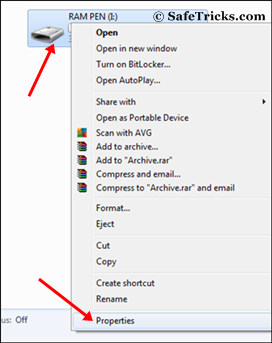
  • Firstly insert your “Pen Drive” >> Now right click on your pendrive.
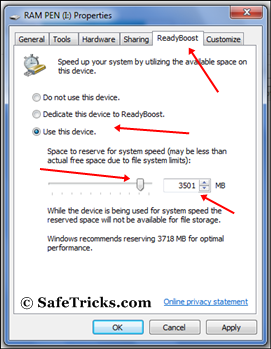
  • Open “Properties” >> Then “ReadyBoost” tab.
PenDrive Properties
  •  Then switch to “Use this device” and reduce your current memory space. If your current device place is 3700MB then reduce it with approx 200-300MB.
Pendrive Readyboost
  • Then click on Apply button and all Done.
  • In case if you want to change back your pendrive to normal. Then switch it back Don’t use device in Readyboost tab.

Important Recommendations:-

  • Always safely eject your Pendrive. Direct removal may leads to device damage.
  • In Virtual Memory method, If you want to convert back your Pendrive into Normal. Then again open Virtual Settings and remove custom memory value and choose Default settings by checking “Automatically Manage Paging Size”.
  • If you use ReadyBoost method, don’t forget to revert back to normal or otherwise open your pendrive and delete Readyboost file from your pendrive.
In conclusion, these best possible ways to use pendrive as ram in windows and we hope you find them helpful and knowledgeable. In case we missed anything please let us know in comments below.
https://www.safetricks.com/how-to-use-pendrive-as-ram-windows/ http://www.wikihow.com/Use-Pen-Drive-As-RAM


Introduction to RSS

Introduction
You may have noticed when browsing Bleeping Computer that there are these little orange RSS buttons all over the place that look like . You may haved wondered what these were and, being an adventurous sort, you click on them and your screen becomes filled with strange codes that make no sense to you. I know you are confused, but there really is a good reason for these buttons. These buttons are called RSS feeds and they can make your life much easier. Don't believe me? Then continue reading to learn what RSS is and how it can help you.
RSS
A common practice among blogs and news sites is to syndicate their content. Web syndication is when content from a web site is made available for other sites or remote applications to use. The most common method for web syndication is to use a protocol called Really Simple Syndication or more commonly known as RSS. RSS is a protocol that allows web sites to make their content, or portions of their content, available to other other sites or applications.
When a web site syndicates content using RSS they create RSS feeds or channels. The channels are usually created in such a way that they cover a particular subject. For example, each of the forums in the Bleeping Computer forums section has its own individual RSS feed or channel as shown at our RSS Page. Each forum is a separate channel as they all have a different subject matter. That is not to say that a web site could not create a RSS feed that covered many subjects, because they could, but it would not be the most efficient way of creating their feeds. This is because people who use RSS use it to find specific subject matter that they want to learn or read about. If a web site publishes an RSS feed that covers many subjects, that person may not use that feed because they would have to search through all the information in the feed to find what they want.

Why would I want to use RSS?
Now that you understand what RSS is, you are probably wondering why you would to use it. The answer is simple! To save you time and effort in finding the information and news that is specifically relevant to your interests. RSS allows you to subscribe to feeds that pertain to subjects that interest you. You can then have all these feeds aggregated into one location, such as a web site or software application, where you can view it quickly and in an organized manner.
A common use of RSS feeds is to import data from another web site into your own. For example, lets say that you want to add news items to your site, but do not have the resources to gather or create this news. By using RSS you can instead add news to your site by importing it from another site that has syndicated their content using RSS. This saves you time and energy because you do not have to create the content yourself, but can use someone elses. Note that if you do add someone's syndicated content to your site, it goes without saying that you should give credit back to the originating site.
For personal use, you can use something called a feed aggregator. These are pieces of software that allow you to subscribe to various feeds you find throughout the Internet and aggregate them into one location, namely the software that you are using. Then when you start the software, and have it check for new updates, your software will connect to all these feeds and download any new information and display it to you. This allows you to have all the news or resources that interests you from your favorites web sites organized into one location where you can easily see if there is new content to be read. A good example is if you frequent 10 different message boards and they have RSS feeds for the forums on them, you can add their RSS feeds to your aggregator and see any new topics that are posted without having to visit each of these sites!! Then when reading a particular entry, if you actually want to go to the site, you can click on the link that will be shown with the news item


FIREWALL

A firewall is a hardware device or software application that sits between your computer and the Internet and blocks all Internet traffic from reaching your computer that you have not specifically requested. What this means is that if you browse to a web site, the firewall will allow the traffic from that web site to reach your computer and therefore yourself. On the other hand, if you did not request information from that web site, and the web site sent traffic to you, it would be denied from reaching your computer because you did not specifically ask for it.


Firewalls for the home user can either be a piece of hardware or a piece of software. The differences will be discussed below.
A Hardware Firewall is a device that sits between your Internet connection and the rest of the computers plugged into it. These firewalls usually come with a built in hub that allows you to connect multiple computers to it in order for them all to be able to share one Internet connection. These firewalls provide protection to all the computers connected to it using a technology called Network Address Translation, or NAT. This protection is performed by all the protected machines using private IP addresses, such as 192.168.1.X, that can not be reached via the Internet. The firewall then convert these internal IP addresses to the single public IP address that is assigned to the firewall. This makes it so that your hardware firewall accepts all incoming requests you asked for and then forwards them on to the requesting internal computer. Using this method, outside machines are never able to connect directly to your computers.
A Personal Firewall is a piece of software installed on each computer that needs to be protected. This software then filters all incoming, and sometimes outgoing traffic, and only allows only data that has been requested or explicitly allowed to pass through. Personal firewalls tend to be more feature rich than hardware versions, but they do not have the ability to allow you to share your Internet connection with multiple computers on the network.